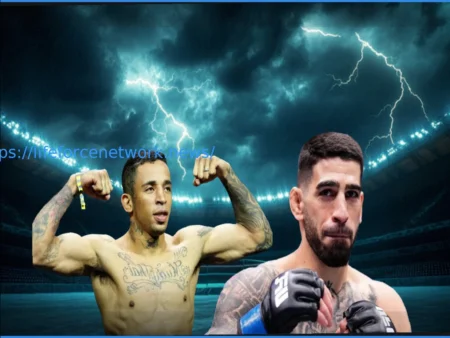


Get ready, fight fans! On July 11, 2026, during the highly anticipated International Fight Week at the T-Mobile Arena in Las Vegas, two of mixed martial arts’ most iconic figures, Conor McGregor and Max Holloway, will face each other once again. This bout marks their first encounter since the memorable August 2013 fight at UFC Fight Night: Shogun vs. Sonnen, a time long before they achieved global superstardom.
Thirteen years later, they step back into the Octagon at UFC 329, each carrying a vastly different legacy. This highly anticipated matchup promises to be a spectacle, underscoring the immense global appeal of the UFC.
UFC 329: Details and Significance
The rematch is slated to take place at welterweight, adding a compelling new dimension to this historic clash. Neither fighter established their legendary status in the 170-pound division. McGregor famously became the UFC’s first simultaneous two-division champion in the featherweight and lightweight classes, while Holloway dominated the featherweight division with one of the longest championship reigns in UFC history. Their collision at welterweight highlights the realities of age, accumulated wear and tear, and fighter evolution. Both are older, more seasoned, physically altered, and at a career stage where legacy outweighs rankings. UFC 329 transcends a typical rematch; it represents a convergence of past and present in mixed martial arts.
For Conor McGregor, this fight signifies his return to the UFC for the first time since July 2021, when he suffered a severe leg injury against Dustin Poirier. After nearly five years away from active competition, the Irish superstar faces immense scrutiny. Questions about his motivation, discipline, physical condition, and ability to compete against top-tier opponents have persisted. Can he silence his doubters and return to winning ways? UFC 329 is more than just another comeback attempt for a fighter who has long transcended his sport; it could be the defining final chapter of one of MMA’s most influential careers.
For Max Holloway, this rematch is about settling unfinished business, as he currently holds a 0-1 record against McGregor. He has transformed from the young prospect who faced McGregor in Boston into one of MMA’s most respected and accomplished fighters. A former champion himself, Holloway has experienced title reigns, grueling battles, significant setbacks, and historic victories since their initial encounter over a decade ago. Despite his impressive accolades, the loss to McGregor remains a lingering element of his career narrative. Can he even the score and get his revenge against the legend? Such a victory would undoubtedly add profound depth and meaning to his already remarkable legacy.
Historical Context and Previous Fight Analysis
The first encounter between Conor McGregor and Max Holloway took place on August 17, 2013, at UFC Fight Night 26 in Boston. At that point, neither fighter had cemented their status as major MMA stars, yet their immense potential was evident to many observers. McGregor entered the UFC with significant hype from Cage Warriors, where he had already captured two divisional titles. His charisma, outspoken nature, precise striking, and unshakeable confidence marked him as a future champion. His UFC debut earlier that year against Marcus Brimage lasted just over a minute, instantly signaling him as a serious featherweight prospect.
Holloway, then just 21 years old, was still developing. While he had shown flashes of brilliance, he lacked the polish and experience that would define his championship years. He was recognized as a durable, exciting Hawaiian striker with potential, but few predicted he would become one of the sport’s most prolific volume punchers. He entered that bout as a slight underdog, eager to prove himself early in his career.
The fight itself unfolded in an interesting manner. McGregor started aggressively, utilizing his movement and timing to control the distance. His left hand consistently found its mark, and his kicks disrupted Holloway’s rhythm. Holloway struggled to establish his offensive combinations as McGregor dictated the pace. Crucially, McGregor suffered a torn ACL during the fight, a fact he later revealed he fought through significant knee damage. This injury forced him to adapt his strategy, relying more heavily on grappling and top control.
This tactical shift became a testament to McGregor’s composure and fight IQ, showcasing his ability to adjust mid-bout, a facet often overlooked given his reputation as a pure striker. He secured takedowns, maintained dominant positions, and limited Holloway’s opportunities. Holloway demonstrated resilience, remaining dangerous even as the younger, less experienced fighter. While his signature pressure and boxing combinations began to surface at times, McGregor’s early lead and effective grappling proved decisive.
McGregor ultimately won by unanimous decision, with all three judges scoring it 30-27. In retrospect, the fight is historically fascinating as it featured two future legends before they reached their primes. McGregor had not yet defeated José Aldo, become a double champion, or revolutionized combat sports economics. Holloway had not yet embarked on his legendary featherweight reign or engaged in memorable wars with fighters like Calvin Kattar and Justin Gaethje. The bout stands as a time capsule from a different era of the UFC, offering a valuable opportunity for reflection and analysis.
The Stakes for McGregor
A victory for Conor McGregor over Max Holloway at UFC 329 would represent one of the most significant comeback triumphs in UFC history. The skepticism surrounding him is substantial: he hasn’t competed in nearly five years, is approaching 38, and is returning from a debilitating leg injury. His lifestyle outside the cage has been heavily scrutinized, and many question his ability to defeat elite competition. A second win against Holloway would immediately silence much of this criticism and fundamentally reshape the narrative of McGregor’s later career. Instead of being primarily remembered for a decline and inactivity post-2016, he would possess a defining late-career achievement against a highly respected contemporary fighter.
Furthermore, it would validate the idea that his timing, power, and fight IQ remain elite, especially against a fighter like Holloway, who is notoriously difficult to overwhelm with pressure or durability. Commercially, a win would reignite endless possibilities, positioning McGregor once again as the UFC’s premier pay-per-view attraction and sparking conversations about title contention, blockbuster rematches, and major crossover events. Most importantly, a victory could allow McGregor to reclaim a portion of the aura of inevitability that once defined him, potentially restoring some of the mystique that made him a global phenomenon.
The Significance for Holloway
For Max Holloway, defeating McGregor now would serve as both revenge and validation. While he has arguably built a more substantial overall MMA resume since their first meeting, McGregor’s 2013 victory has always been a part of their shared history. Holloway has spent over a decade evolving, while McGregor achieved superstardom. This rematch offers Holloway the chance to definitively close that chapter. Moreover, while Holloway continued to compete at the highest levels, McGregor’s career trajectory has been more fragmented.
A win would solidify Holloway’s status as one of the greatest featherweights and lower-weight fighters in UFC history. It would demonstrate that while McGregor’s commercial peak may have been more dazzling, Holloway’s sustained excellence has proven more enduring competitively. There is also symbolic importance in defeating McGregor at this stage. Holloway embodies activity, consistency, and perseverance, having remained in the trenches of elite competition year after year, contrasting with McGregor’s more intermittent career. A victory over McGregor now would represent a triumph of longevity and dedication over celebrity.
This win would also elevate Holloway’s cross-generational legacy. Few fighters can claim significant victories spanning multiple UFC eras, with over a decade between fights. Holloway has remained relevant through changing divisions, champions, and fighting styles. Emotionally, a victory could be immensely significant. Fighters rarely get the chance to revisit defining moments from their youth, and Holloway’s loss to McGregor occurred before either man reached legendary status. Defeating him now, after all they have experienced, would offer one of the sport’s most poetic full-circle moments in years.
A Classic Awaits, Regardless of the Outcome
The stage is set, and the date is confirmed. Dana White is once again delivering a highly anticipated matchup for the fans. Neither fighter will be at their absolute physical peak as they were in their younger days; time and accumulated damage inevitably take their toll, affecting reflexes and shifting priorities. However, this dynamic can elevate the stakes. Fans will be watching not just to see who wins, but to witness if McGregor can still summon greatness after years away and if Holloway can finally erase the memory of his first defeat. This July, two icons will confront their past and battle the passage of time in front of the entire MMA world.