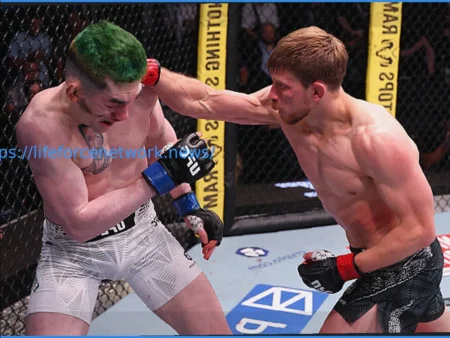


Last weekend, a strategic battle for audience attention unfolded between the UFC and Most Valuable Promotions (MVP). As Netflix aired its inaugural live MMA event featuring Ronda Rousey, the UFC simultaneously announced Conor McGregor’s return on July 11th at UFC 329 against Max Holloway. This created a compelling narrative around who captured the public’s interest more effectively. While the UFC aimed to overshadow MVP’s event, Google Trends data offers a clearer picture of the search interest generated by each announcement.
On Sunday morning, May 18th, two major events vied for attention: a swift 17-second fight on Netflix and an eight-word announcement on X confirming McGregor’s comeback after a five-year hiatus. An examination of Google Trends data sheds light on the outcome of this attention war.
Rousey’s Quick Victory on Netflix
Ronda Rousey made her MMA comeback on May 16th at the Intuit Dome in Inglewood, broadcast live on Netflix to an audience of 325 million subscribers. Her opponent was Gina Carano, who was returning to the sport after a 17-year absence. The fight concluded in a mere 17 seconds with Rousey securing a submission victory via armbar.
McGregor’s Highly Anticipated Return Announced
On the same evening, the UFC leveraged social media to announce that Conor McGregor would face Max Holloway at UFC 329 on July 11th in Las Vegas. This announcement was perceived as a direct response to MVP’s event. Jake Paul, co-owner of MVP, accused the UFC of attempting to capitalize on their event.
Google Trends Reveals the Search Winner
Google Trends data for the United States between May 11th and May 18th indicates a significant disparity in search interest. Ronda Rousey’s search queries peaked at a maximum indexed value of 100 immediately following her fight on May 17th. In contrast, Conor McGregor’s search queries reached only 9 during the same period. Gina Carano, despite her long layoff, garnered a peak search interest of 75, while Nate Diaz, who also competed on the MVP card, reached 27.
It is important to understand that Google Trends measures search interest on a scale of 0 to 100, with 100 representing the highest search volume for a term within a specified timeframe and region. Thus, when Rousey scored 100 and McGregor scored 9, it signifies that for every nine searches related to McGregor, Rousey received approximately 111 searches.
Analyzing search share across English-speaking markets, Rousey held a dominant position against McGregor. She commanded 89% of the combined search share in the US and Canada, 81% in Australia and South Africa, and 77% in the UK. McGregor’s strongest search presence was observed in Tajikistan (83%) and Turkmenistan (84%), while in his home country of Ireland, Rousey still held a slight advantage at 53% to 47%.
Further insights come from breakout search queries. For McGregor, the most significant rising search term was “Conor McGregor vs Max Holloway tickets,” which increased by over 4,900%. Notably, queries for “Rousey vs Carano” and “Ronda Rousey vs Gina Carano” also appeared within McGregor’s rising terms, indicating that even those initially searching for McGregor were also looking up information about the MVP event.
The data suggests that Rousey’s event generated active search behavior, driven by a desire for information and results. McGregor’s announcement, however, seemed to travel through passive consumption channels such as news alerts and social media posts. While both methods achieve reach, active searching translates into measurable Google traffic, explaining why McGregor’s search numbers appear lower despite extensive media coverage.
Social Media Buzz Favors McGregor
On social media platforms, the narrative shifts. McGregor’s statement on X quickly went viral, generating significant conversation. UFC 329 also trended on Google on May 17th. However, in absolute terms, Rousey’s search volume remained substantially higher.
Ultimately, the weekend resulted in a split victory. Rousey clearly won the search engine attention war, with an 11-fold lead in the US. McGregor, however, dominated the broadcast news cycle and social media conversation. For both MVP and the UFC, the long-term business momentum remains less clear, with Rousey retiring, MVP’s viewership figures unconfirmed, and McGregor’s highly anticipated return set for a July pay-per-view event.
The Verdict
Industry expert Dave Meltzer provided further context, noting that the Rousey vs. Carano fight was listed as a movie on Netflix, achieving a notable global ranking. This classification, coupled with its performance against a major WWE event, suggests substantial viewership, particularly in North America. Meanwhile, UFC’s recent viewership on Paramount+ was reportedly below expectations.
The differing search trends likely reflect a generational and platform-based divide in the audience. Netflix attracted a broader, more casual audience who may not be dedicated MMA followers but were drawn by Rousey’s name recognition. These viewers actively sought information about the event. In contrast, McGregor’s established fanbase likely didn’t need to search for him; they were already engaged on social media following the announcement.
The weekend can best be described as a split decision: Rousey dominated search interest, while McGregor commanded the mainstream news and social media narratives. Both events successfully captured attention through different means, catering to distinct audience segments.