
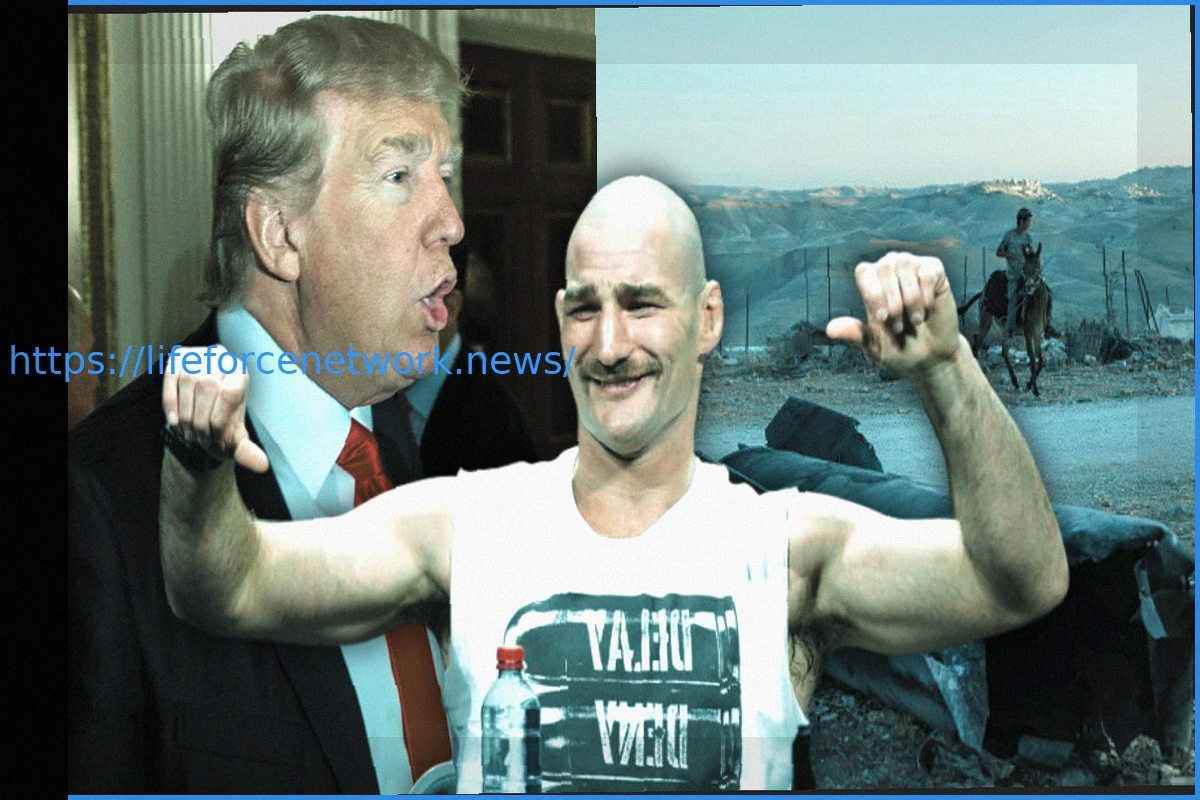
Former UFC middleweight champion Sean Strickland has leveraged his prominent social media platform to vehemently criticize President Donald Trump’s handling of the ongoing conflict with Iran. Strickland argues that the war disproportionately burdens working-class Americans through escalating costs and risks dangerous nuclear escalation, reflecting broader public anxieties about energy markets, inflation, and the U.S.-Iran nuclear standoff.
Strickland’s Sharp Critique of Donald Trump
Strickland’s extensive critique goes beyond a mere outburst, forming a populist argument against the war’s justification and financial toll. He controversially asserted that achieving Trump’s objectives in Iran would necessitate extreme measures, questioning the ultimate aim of a campaign that has already involved significant strikes on Iranian infrastructure. Strickland highlighted U.S. demands, including halting missile development, proxy support, and uranium enrichment – points that mirror longstanding U.S. and Israeli red lines. Furthermore, he provocatively suggested that leaders should send their own children to war, emphasizing a perceived disconnect between decision-makers and those on the front lines.
He accused Trump of “betraying the blue collar guys” by directly linking the conflict to increased fuel, shipping, and everyday living expenses for average Americans. This claim is supported by real-world data, showing significant increases in tanker rates from the Middle East to Asia and spikes in global oil and gas prices following disruptions in the Strait of Hormuz.
The War’s “Blue Collar” Bill: Impact on Hormuz and Everyday Costs
The backdrop for Strickland’s concerns is a conflict that has severely impacted one of the world’s most critical energy transit points. Disruptions in the Strait of Hormuz have drastically reduced tanker traffic, reportedly from about 24 crude carriers daily to just four, leaving numerous loaded vessels stranded. Analysts estimate that nearly 20 percent of the world’s oil and liquefied natural gas supply typically transits this corridor, directly contributing to elevated pump prices, freight costs, and utility bills across the U.S., Europe, and Asia.
These economic pressures are now reflected in macroeconomic forecasts, with the OECD projecting U.S. inflation to reach approximately 4.2 percent this year, a higher figure than earlier projections, citing the Iran conflict’s impact on energy prices as a primary factor.
Nuclear Risks and Trump’s Ultimatum
Strickland also expressed deep skepticism regarding official justifications centered on Iran’s nuclear program. He dismissed these arguments as lacking logical basis, questioning how the specter of “nukes” or Iran “funding random groups with AKs” genuinely improves the lives of Americans, especially after two decades of similar warnings. This skepticism is particularly relevant as Iran’s nuclear activities are under intense scrutiny following reported U.S. and Israeli airstrikes in 2025 that damaged several sites. Despite these attacks, satellite imagery and expert analyses indicate Tehran is actively rebuilding facilities, such as the Taleghan 2 complex at Parchin, and continuing work elsewhere. Recent incidents near the Bushehr nuclear power plant and the heavy-water production site at Khondab even prompted rare public expressions of concern from the International Atomic Energy Agency.
Trump’s Dire Warnings and the Looming Deadline
Adding to the nuclear and economic tensions is President Trump’s own stark rhetoric, which has intensified fears of a wider catastrophe. He reportedly issued a firm deadline, threatening “total destruction” of critical Iranian infrastructure if Iran failed to reopen the Strait of Hormuz. In a widely reported statement, Trump warned that “a whole civilization will die tonight” if Tehran refused to yield, a threat met with defiant vows of resistance from Iranian leaders. Commentators often view the UFC as a crucial channel for Trump’s political messaging, providing a direct link to young male voters. Therefore, a high-profile fighter publicly breaking ranks on a war Trump champions as essential security represents significant dissent within an arena usually considered safe for his political narrative.
Kharg Island: Another Economic Flashpoint
Kharg Island has emerged as another critical flashpoint, directly feeding into the economic concerns raised by fighters like Strickland. The U.S. has reportedly executed multiple “large-scale precision strikes” on the island in recent weeks, targeting over 90 Iranian military sites, including naval mine depots, missile bunkers, air defenses, and a naval base. Officials have repeatedly emphasized that oil and gas terminals have been deliberately spared, even during confirmed raids on April 7. Washington portrays this as a strategy to curb Iran’s capacity to threaten shipping in the Strait of Hormuz without obliterating its primary crude export hub. This precarious approach keeps global markets on edge and further complicates the question of what tangible benefits this conflict offers to those grappling with rising fuel costs.
In this tense environment, Strickland is challenging the president to clearly articulate how this costly conflict serves the interests of ordinary Americans, who are directly experiencing its economic repercussions through higher fuel, shipping, and monthly expenses. This political outspokenness comes as Strickland continues his ascent in the sport, with a highly anticipated main event clash against reigning middleweight champion Khamzat Chimaev at UFC 328 on May 9 at the Prudential Center in Newark.