

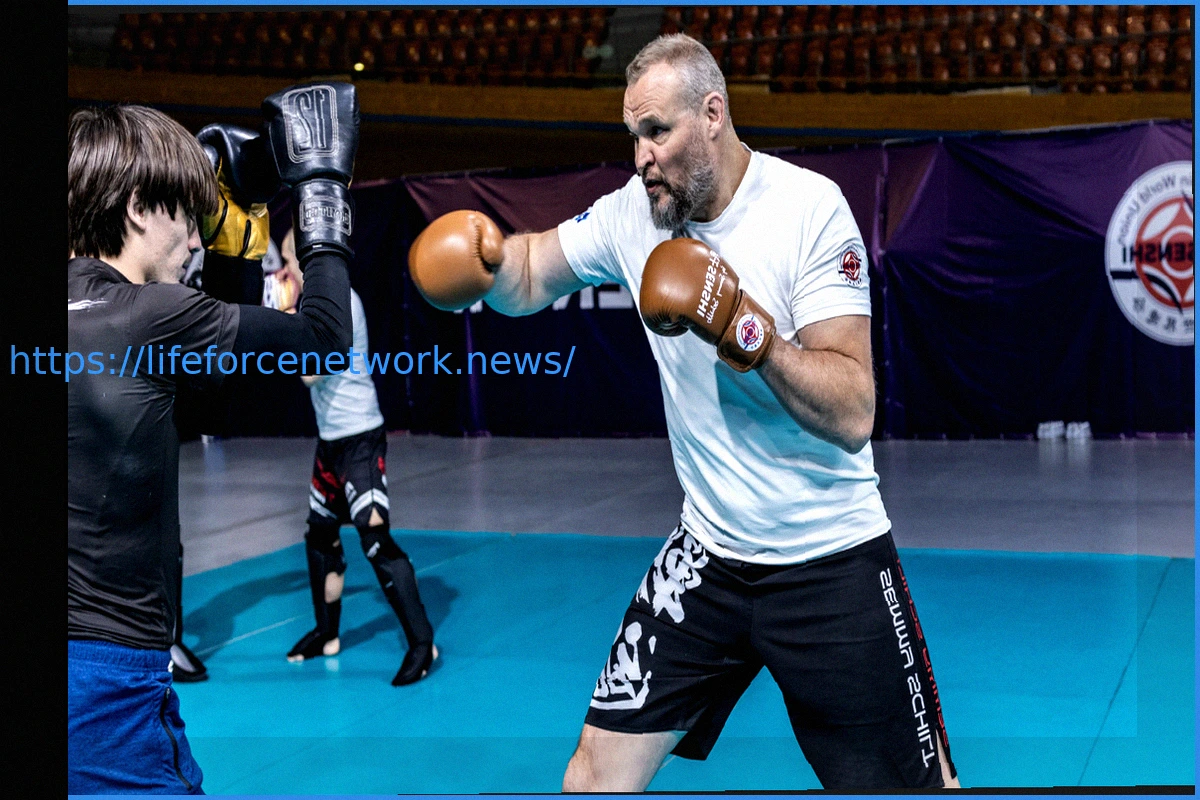
Standing at an imposing 2.12 meters, Semmy Schilt is unmistakable. The four-time K-1 World Grand Prix champion and President of KWU SENSHI Europe, known for his self-awareness as much as his dominance in the ring, recently spoke in Plovdiv ahead of SENSHI 31 Gladiators.
Semmy Schilt on Pancrase and Yuki Kondo
Schilt’s professional journey began in 1996 within the unique environment of Pancrase, a Japanese organization founded by Masakatsu Funaki that bridged the gap between submission wrestling and what would become mixed martial arts (MMA). One of his early adversaries was Yuki Kondo, a tenacious Japanese fighter who amassed over 100 professional bouts from 1996 to 2022.
Their initial encounter occurred at the 1996 Pancrase Neo-Blood Tournament on July 22, where Kondo emerged victorious by split decision. “He was a strong fighter,” Schilt reminisced. “He was also upcoming, just like me. We were fighting in the Neo Blood tournament, and at that time I had just come into Pancrase. I think my first, maybe two or three fights I had in Pancrase, and then there was a new blood tournament, which was really great because I could fight in a tournament for the first time.”
The rematch at Pancrase Alive 7 on June 30, 1997, saw Kondo win again, this time by unanimous decision. However, the decisive third bout at Pancrase Breakthrough 10 on November 28, 1999, saw Schilt secure a submission victory via rear-naked choke in the first round at 2:28. Schilt fondly remembers the finish: “The next time I fight him, I could make a submission because he walked into it, so I’m really happy for that. But he was a good ground fighter.”
The Pancrase era itself was distinct. The organization utilized open-palm strikes instead of closed fists, a technique rooted in catch wrestling and karate. Schilt, with his striking background, offered a different approach compared to the predominantly Japanese catch wrestlers. “Because I’m coming from karate, and Bas [Rutten] also, our palm strikes are different. We know how to hit. The catch wrestling guys hit with the fingers and it looks tough, but we hit with the palm of the hand, and it’s like, there’s only bone here,” he explained, emphasizing the power behind his strikes.
Schilt also highlighted how Pancrase fostered his development. Initially a karateka and Kudo champion, facing opponents like Kondo on the ground compelled him to adapt rapidly. “Every time it was a new challenge. First the chance for the ground, then the punching on the ground, and then came kickboxing, because I did not do kickboxing before.” This strategic shift proved successful, leading to his four K-1 World Grand Prix titles between 2005 and 2009, making him the sole fighter in K-1 history to achieve three consecutive championships. He further expanded his accolades by winning the Glory Heavyweight Grand Slam in 2012.
SENSHI
Now serving as President of KWU SENSHI Europe and holding a 9th Dan in Ashihara karate, Schilt expressed his pride in the younger generation of fighters at SENSHI. “It gives me goosebumps,” he said upon hearing them describe it as an honor to compete before him. He views SENSHI as a natural progression of his career. “Since SENSHI started for me as the transition from karate to kickboxing, from amateur to professional, it’s exactly my path.”
SENSHI 31 Gladiators is scheduled for May 30 at the Ancient Theatre of Philippopolis in Plovdiv, Bulgaria. The event will feature a SENSHI Grand Prix in the 70 kg division, an eight-man knockout tournament to crown a lightweight champion, along with super fights, including a heavyweight clash between Benjamin Adegbuyi and Daniel Dinev.
English Translation:
Standing at an imposing 2.12 meters, Semmy Schilt is unmistakable. The four-time K-1 World Grand Prix champion and President of KWU SENSHI Europe, known for his self-awareness as much as his dominance in the ring, recently spoke in Plovdiv ahead of SENSHI 31 Gladiators.
Semmy Schilt on Pancrase and Yuki Kondo
Schilt’s professional journey began in 1996 within the unique environment of Pancrase, a Japanese organization founded by Masakatsu Funaki that bridged the gap between submission wrestling and what would become mixed martial arts (MMA). One of his early adversaries was Yuki Kondo, a tenacious Japanese fighter who amassed over 100 professional bouts from 1996 to 2022.
Their initial encounter occurred at the 1996 Pancrase Neo-Blood Tournament on July 22, where Kondo emerged victorious by split decision. “He was a strong fighter,” Schilt reminisced. “He was also up-and-coming, just like me. We were fighting in the Neo Blood tournament, and at that time I had just joined Pancrase. I think it was my first, maybe two or three fights I had in Pancrase, and then there was a new blood tournament, which was really great because I could compete in a tournament for the first time.”
The rematch at Pancrase Alive 7 on June 30, 1997, saw Kondo win again, this time by unanimous decision. However, the decisive third bout at Pancrase Breakthrough 10 on November 28, 1999, saw Schilt secure a submission victory via rear-naked choke in the first round at 2:28. Schilt fondly remembers the finish: “The next time I fought him, I was able to get a submission because he walked into it, so I’m really happy about that. But he was a good ground fighter.”
The Pancrase era itself was distinct. The organization utilized open-palm strikes instead of closed fists, a technique rooted in catch wrestling and karate. Schilt, with his striking background, offered a different approach compared to the predominantly Japanese catch wrestlers. “Because I came from karate, and Bas [Rutten] as well, our palm strikes are different. We know how to hit. The catch wrestling guys hit with their fingers and it looks tough, but we hit with the palm of the hand, and it’s like, there’s only bone here,” he explained, emphasizing the power behind his strikes.
Schilt also highlighted how Pancrase fostered his development. Initially a karateka and Kudo champion, facing opponents like Kondo on the ground compelled him to adapt rapidly. “Every time it was a new challenge. First, the opportunity on the ground, then striking on the ground, and then came kickboxing, because I hadn’t done kickboxing before.” This strategic shift proved successful, leading to his four K-1 World Grand Prix titles between 2005 and 2009, making him the sole fighter in K-1 history to achieve three consecutive championships. He further expanded his accolades by winning the Glory Heavyweight Grand Slam in 2012.
SENSHI
Now serving as President of KWU SENSHI Europe and holding a 9th Dan in Ashihara karate, Schilt expressed his pride in the younger generation of fighters at SENSHI. “It gives me goosebumps,” he said upon hearing them describe it as an honor to compete before him. He views SENSHI as a natural progression of his career. “Since SENSHI started for me as the transition from karate to kickboxing, from amateur to professional, it’s exactly my path.”
SENSHI 31 Gladiators is scheduled for May 30 at the Ancient Theatre of Philippopolis in Plovdiv, Bulgaria. The event will feature a SENSHI Grand Prix in the 70 kg division, an eight-man knockout tournament to crown a lightweight champion, along with super fights, including a heavyweight clash between Benjamin Adegbuyi and Daniel Dinev.